


Exposure to trauma in childhood is associated with elevated risk for multiple forms of psychopathology. Here we present a biopsychosocial model outlining the mechanisms that link child trauma with psychopathology and protective factors that can mitigate these risk pathways. We focus on four mechanisms of enhanced threat processing: information processing biases that facilitate rapid identification of environmental threats, disruptions in learning mechanisms underlying the acquisition of fear, heightened emotional responses to potential threats, and difficulty disengaging from negative emotional content. Supportive relationships with caregivers, heightened sensitivity to rewarding and positive stimuli, and mature amygdala-prefrontal circuitry each serve as potential buffers of these risk pathways, highlighting novel directions for interventions aimed at preventing the onset of psychopathology following child trauma.
Exposure to trauma in childhood is a risk factor for many forms of psychopathology, including post-traumatic stress disorder (PTSD), anxiety, depression, disruptive behaviors, and substance abuse [1–4]. Risk for psychopathology following trauma is most pronounced in children exposed to interpersonal violence [1,3,4]. Identifying mechanisms that underlie the strong link between child trauma and psychopathology as well as factors that buffer this risk is critical in order to develop targets for preventive interventions. In this paper, we review mechanisms that underlie vulnerability to psychopathology following child trauma and protective factors that mitigate risk pathways (see Figure 1). Specifically, we highlight the role of disruptions in threat processing as a central mechanism linking child trauma to multiple forms of psychopathology and identify protective factors spanning social, emotional, and neurobiological levels that may buffer children from the negative mental health consequences of trauma exposure. We specifically focus on innovative recent discoveries and factors that could be directly targeted with psychosocial interventions.
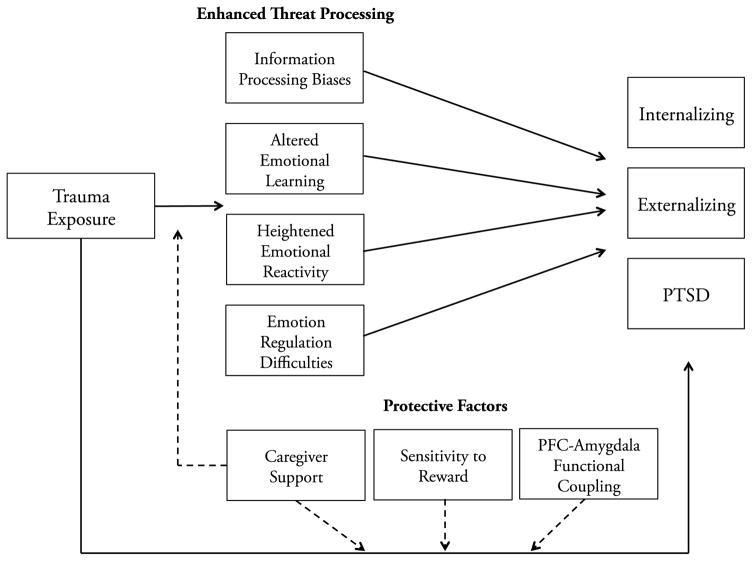

A biopsychosocial model of risk and resilience to psychopathology following child trauma.
This figure depicts a biopsychosocial model of mechanisms linking child trauma with psychopathology and protective factors that mitigate risk pathways. Solid lines reflect direct associations between child trauma and threat processing and between threat processing and psychopathology. Enhanced threat processing is a transdiagnostic factor associated with multiple forms of child psychopathology. Each domain of threat processing is associated with internalizing and externalizing psychopathology, as well as post-traumatic stress disorder (PTSD); although greater research is needed to clarify whether the specific disruptions in emotional learning associated with child trauma are associated with mental health problems other than externalizing psychopathology. PTSD is depicted separately from internalizing and externalizing problems given its current classification as a trauma and stressor-related disorder in DSM-5. Dashed lines represent the buffering effect of each of the protective factors on specific risk pathways.
Trauma Exposure and Threat Processing
Traumatic events involve harm or threat of harm [5]. This is particularly true for traumatic events involving exposure to interpersonal violence, including physical abuse, sexual abuse, witnessing domestic violence, and exposure to other forms of violence in the home or community. Approximately one in five children in the U.S. will experience a traumatic event involving interpersonal violence by the time they reach adulthood [4]. Exposure to these types of traumatic events in childhood alters affective and neurobiological development to enhance the identification of potential threats in the environmental and magnify emotional responses to those threats. Although these adaptations may promote safety in dangerous environments, they are a central mechanism linking child trauma to the onset of both internalizing and externalizing psychopathology. We review evidence for heightened threat processing at multiple levels—including social information processing biases, altered emotional learning, elevated emotional reactivity, and emotion regulation difficulties—as a developmental mechanism linking child trauma with psychopathology. Given that disruptions in threat processing and risk for psychopathology are particularly pronounced in children who have experienced interpersonal violence, we focus primarily on this form of child trauma exposure. We constrain our review to domains of threat processing that present plausible targets for psychosocial interventions, although additional mechanisms clearly play a role in the pathways linking child trauma to psychopathology, including changes in stress hormones and epigenetic factors [6].
Social Information Processing Biases
Trauma-exposed children exhibit information processing biases that facilitate rapid identification of environmental threats. One such bias involves heightened perceptual sensitivity to anger. Children with trauma histories identify anger with less perceptual information and classify a wider range of emotions as anger than children who have never experienced trauma [7–9]. Trauma-exposed children also exhibit attention biases to threatening social information [10], including faster attentional engagement and delayed attentional disengagement from anger [11,12]. In social situations, extensive evidence documents that children exposed to trauma are more likely to attend to threatening cues, ignore non-threatening cues, and generate hostile attributions than children without trauma histories [13].
Enhanced threat processing may occur at the expense of processing non-emotional aspects of the environment. Specifically, trauma-exposed children have poor memory for contextual information that occurs in the background of threatening cues as well as reduced activation of the hippocampus and atypical hippocampal-prefrontal cortex functional connectivity when contextual encoding occurs in the presence of threat [14]. Heightened attention to threat following child trauma may interfere with processing contextual information that could help children discriminate between safe and dangerous environments. This pattern might ultimately contribute to psychopathology by making it difficult for children to contextualize cues that have previously been associated with threat, leading to persistent fear even in safe environments.
These disruptions in social information processing are developmental mechanisms that underlie the association of child trauma with anxiety [12], PTSD [15], aggression and conduct problems [10,13].
Altered Emotional Learning
Disruptions in learning processes involved in the acquisition and extinction of conditioned fear are considered a central mechanism in the etiology of trauma-related psychopathology [16], but have rarely been studied in children. A recent study shows that whereas children without trauma exposure exhibit robust discrimination in skin conductance responses (SCR) during fear conditioning between cues that predict threat (CS+) and safety (CS−), trauma-exposed children fail to discriminate between threat and safety cues, exhibiting SCR of similar magnitude to both types of cues [17]. This pattern could reflect either generalization of fear, whereby children exposed to trauma interpret a wider range of cues as potential threats, or difficulty learning safety signals. Poor threat-safety discrimination mediates the association of child trauma with externalizing problems [17], indicating that perturbed fear learning is a potential mechanism linking child trauma to psychopathology.
Heightened Emotional Reactivity
Children exposed to trauma exhibit exaggerated emotional responses to negative stimuli that could signal the presence of threat, which serves as an additional mechanism linking child trauma with psychopathology. Heightened emotional reactivity following child trauma has been observed at both state and trait levels [18,19], and in magnified negative emotional reactions to daily stressors in adulthood [20]. Elevated amygdala response to numerous types of negative stimuli has been observed among trauma-exposed children [21–23], suggesting that negative emotional cues are particularly salient following child trauma. Atypical physiological responses to stress have been consistently observed in trauma-exposed children. Here we focus on recent work examining physiological patterns based on a well-validated model of threat responding, where threat appraisals produce a pattern of autonomic nervous system (ANS) response characterized by increased sympathetic nervous system activation but constricted cardiac output (i.e., blood flow from the heart) due to peripheral vasoconstriction [24]. Two studies have documented this threat pattern of ANS reactivity to stress among adolescents with trauma histories [25,26].
Magnified emotional reactivity to negative stimuli is associated with concurrent psychopathology [25,26] and mediates the association of child trauma with both internalizing and externalizing problems [18,27,28]. Heightened amygdala response to negative stimuli assessed prior to trauma exposure predicts the onset of PTSD symptoms following a traumatic stressor [29] and increases in internalizing symptoms following stressful life events [30].
Emotion Regulation Difficulties
Trauma-exposed children also experience disruptions in emotion regulation that make it difficult to disengage from negative emotional content. For example, frequent engagement in rumination—a strategy characterized by repetitive thought about the causes and consequences of distress—is common among trauma-exposed children [18]. Effortful emotion regulation strategies that modulate responses to negative stimuli, such as cognitive reappraisal, require greater cognitive resources or effort for children who have experienced trauma; when engaging in cognitive reappraisal, children exposed to trauma recruit prefrontal cortex regions involved in cognitive control to a great degree than children without trauma exposure [23]. Several recent studies have documented poor adaptation to emotional conflict, a form of implicit emotion regulation, among trauma-exposed children [31,32]. These trauma-related behavioral differences are mediated by reduced functional coupling of amygdala and medial prefrontal cortex (mPFC) [32]. The mPFC inhibits the amygdala in numerous forms of implicit emotion regulation. Reduced resting-state mPFC-amygdala functional connectivity has been observed in multiple studies of trauma-exposed adolescents [33,34], highlighting a potential neural substrate of implicit emotion regulation difficulties.
Patterns of emotion regulation observed in trauma-exposed children have been associated consistently with youth internalizing and externalizing psychopathology [35,36], and, when measured prior to trauma exposure, predict the subsequent onset of PTSD symptoms following a traumatic event [37]. Longitudinal studies confirm that emotion regulation difficulties are a mechanism linking child trauma to the onset of internalizing and externalizing symptoms [18,38].
Protective Factors
Protective factors spanning social, emotional, and neurobiological domains may buffer children either from enhanced threat processing or from experiencing psychopathology following exposure to trauma.
Caregiver Support
Relationships with caregivers play a key role in protecting children from the onset of trauma-related psychopathology. Meta-analytic evidence indicates that children who have supportive caregivers are less likely to develop psychopathology following trauma exposure [39]. Recent work highlights a potential mechanism for this protective effect: maternal buffering of threat processing. Cues that signal maternal presence are associated with dampened amygdala reactivity and greater mPFC-amygdala functional connectivity in children, particularly those who have a supportive relationship with their mother [40]. Similarly, maternal presence enhances threat-safety discrimination during fear conditioning in children [41]. Critically, amygdala reactivity to threatening cues following trauma exposure is weaker in children with high maternal support [42]. Together, these findings suggest that one pathway through which social support might confer protection from trauma-related psychopathology is by dampening threat processing after a traumatic event.
Sensitivity to Reward
Sensitivity to positive and rewarding stimuli at both neural and behavioral levels is associated with reduced risk for psychopathology following child trauma exposure. Child trauma is associated with anhedonia less strongly in young adults with high ventral striatum reactivity to reward [43]. Lower levels of anhedonia, in turn, are associated with reduced depression symptoms and problematic drinking following child trauma [43]. Similarly, child trauma is not associated with depression, either concurrently or prospectively, among adolescents who exhibit high behavioral sensitivity to reward during a reward-processing task or who exhibit high reactivity to positive social stimuli in the pallidum and putamen—basal ganglia regions implicated in reward processing [44]. These findings are consistent with evidence that the association of stressful life events with depression is weaker among individuals with high ventral striatum reactivity to reward [45]. Accumulating evidence suggests that sensitivity to rewarding and positive cues may protect against the development of trauma-related psychopathology. Identifying the mechanism of this protective effect is an important direction for future research.
Mature Prefrontal-Amygdala Circuitry
As reviewed above, child trauma influences numerous forms of emotion regulation and the neural circuitry that supports effective regulation. However, some aspects of emotion regulation ability appear to interact with childhood adversity, serving as a protective factor against the development of internalizing psychopathology. Two recent studies suggest that greater mPFC-amygdala functional coupling—a marker of mature emotion regulation neural circuitry [46]—is a protective factor that buffers children from the onset of psychopathology following environmental adversity. In both studies, greater mPFC-amygdala functional connectivity during a threat-processing task predicts lower levels of internalizing psychopathology among children who experienced early adversity—including institutional rearing and diverse family-related stressors [47,48]. Greater research is needed to clarify the direct links between trauma and mPFC-amygdala circuitry and the circumstances in which this circuitry protects against trauma-related psychopathology.
Intervention Implications
Numerous evidence-based interventions exist for treating trauma-related psychopathology in youth [49]. Cognitive behavioral therapy (CBT) is currently the most well-established treatment for child trauma-related psychopathology [49] and targets many of the threat processing mechanisms reviewed here. CBT for child trauma targets social information processing biases with cognitive coping techniques, emotional learning with imaginal and in vivo exposure, emotional reactivity with relaxation training, and emotion regulation with affective modulation skills. CBT also incorporates parents into the treatment with techniques aimed at improving parenting skills and bolstering the parent-child relationship. These components may further improve caregiver support, a key protective factor that buffers children from trauma-related psychopathology. A critical future direction for the field is to determine whether these intervention techniques targeting threat processing and caregiver support can prevent the onset of psychopathology in children exposed to trauma. One study shows promising results of a skill-based intervention delivered to both parents and children in preventing child PTSD and anxiety 3-months following trauma exposure [50]. It is currently unknown whether interventions targeting reward processing (e.g., behavioral activation) can prevent trauma-related psychopathology, as these approaches have yet to be examined empirically in children with trauma exposure. Greater research on preventive interventions following child trauma is clearly needed.
Conclusion
Disruptions in threat processing are a key neurodevelopmental mechanism underlying the associations between child trauma and the onset of psychopathology. Enhanced threat processing occurs at multiple levels, including information processing biases, altered emotional learning, enhanced emotional reactivity, and poor emotion regulation. Supportive relationships with caregivers, heightened sensitivity to rewarding and positive stimuli, and mature prefrontal-amygdala circuitry each serve as potential buffers of these risk pathways, highlighting novel directions for interventions aimed at preventing the onset of psychopathology following child trauma.
Need support? Tranquility Clinic treats addiction alongside the mental health conditions that often come with it. Learn about our inpatient treatment and aftercare programme, or take our free, confidential self-assessment.